An Unclear Unit of Measurement
The difficulty of understanding Leonard of Scio’s measurements becomes even clearer when we consider how medieval writers used the word “stadium.” According to Du Cange, in his famous glossary of medieval and later Latin, the stadium was considered a type of measurement, but one that was completely uncertain in length. He describes it as “a kind of measure, but entirely unknown.” This statement strongly supports the view that the word stadium had no fixed or reliable meaning in the Middle Ages The Gate of Saint Demetrius and Its Names.
Because of this uncertainty, any attempt to calculate exact distances from Leonard’s use of stadia is extremely risky. The term could vary widely in meaning depending on the writer, the region, or even the context in which it was used.
Zorzo Dolfin’s Translation of Leonard’s Account
Further confusion arises from the way Zorzo Dolfin translated Leonard’s description of the ships being moved across the hills. Dolfin explains that the Sultan ordered the roads to be leveled and the ships to be placed on supports, which were then dragged by force of arms. He states that this movement took place over seventy stadia, which he then loosely explains as being equal to several miles.
However, the exact number of miles is not clearly stated. Either Dolfin did not know the precise equivalent, or the figure was missing from the text he used. This uncertainty has caused generations of historians to debate the true distance covered by the ships.
If Leonard or his translators had clearly stated the number of miles, or if that number had survived in the manuscripts, much confusion and disagreement among scholars could have been avoided. Instead, historians have been left to guess, interpret, and argue over a term that had no fixed value Holidays Bulgaria.
The Limits of Leonard’s Evidence
Because of these problems, Leonard’s account cannot be used to determine the exact route taken by the Ottoman ships. While his description of the method—leveling roads, placing ships on supports, and dragging them over hills—is valuable, his measurements are not dependable. His use of the word stadium adds color to the narrative but very little precision.
As a result, Leonard’s testimony must be treated with caution. It helps us understand what happened, but not exactly where or how far.
The Walls Along the Sea of Marmara
The Extent of the Sea Walls
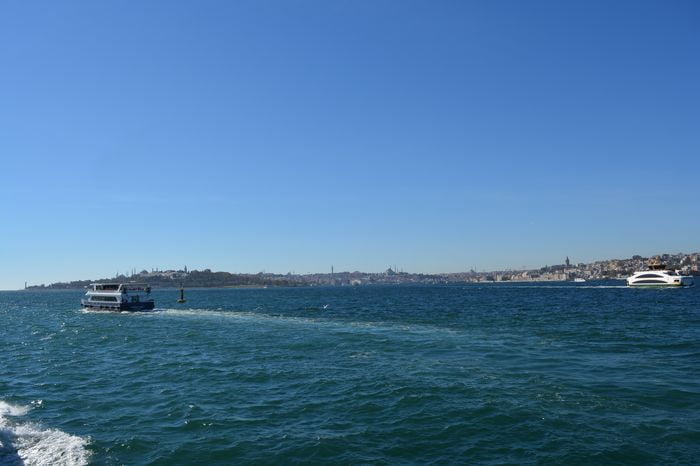
The fortifications along the Sea of Marmara stretched from the Acropolis, also known as Seraglio Point, to the southern end of the great land walls of Constantinople. According to Bondelmontius, this line of defense included 188 towers and extended for about five miles.
Unlike the massive double and triple walls on the landward side of the city, the sea walls were simpler in design. They consisted mainly of a single wall, strengthened at regular intervals by towers.
Strength from the Sea Itself
One of the greatest advantages of the Marmara sea walls was their position. Almost everywhere along their length, they stood very close to the water’s edge. This made it extremely difficult for enemy forces to land troops at their base. Ships could not easily approach without coming under fire from the walls above.
Because of this, the defenders of the city did not have to worry as much about large-scale landings along this coast. Their main task was to defend against naval attacks, which were easier to control than assaults by large armies on land.
Defensive Effectiveness
The sea walls along the Sea of Marmara were not as tall or complex as the land walls, but they were well suited to their purpose. Their towers allowed defenders to watch the sea closely and respond quickly to any approaching enemy ships.
In combination with the natural protection offered by the sea, these fortifications formed a strong and effective barrier. For centuries, they helped protect Constantinople from attack from the south and played an important role in the city’s overall defensive system.
In summary, the unclear meaning of the word “stadium” shows why Leonard of Scio’s measurements cannot be trusted for precise calculations. At the same time, the description of Constantinople’s sea walls along the Sea of Marmara reminds us that the city relied not only on massive land defenses, but also on carefully placed coastal fortifications. Together, these elements formed one of the strongest defensive systems of the medieval world.